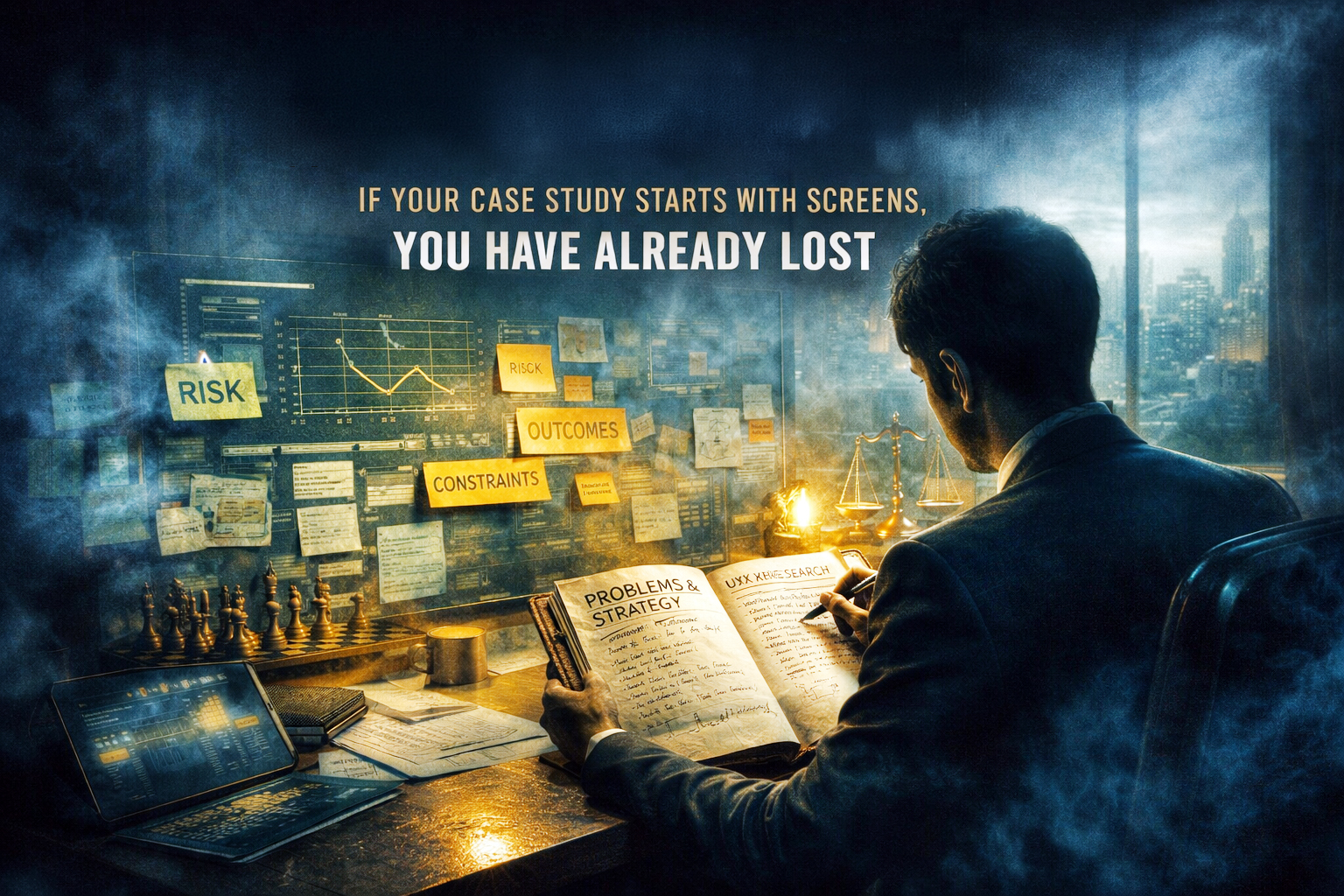

To land a senior UX job in today’s market, your case study must start with the business problem, constraints, and risk, not polished screens. Hiring managers look for trust, leadership, ethics, and clarity. By connecting design decisions directly to revenue, retention, and reduced support load, you signal true executive-level UX accountability and prove your business value.
Trust Leadership: Ethics + Clarity = Senior Signal (Why Starting With Screens Means You’ve Already Lost)
I have spent over 25 years in this industry. I’ve diagnosed complex friction points, run rigorous heuristic evaluations, and built high-converting solutions for massive enterprise and SaaS clients. I’ve also reviewed thousands of portfolios from designers desperately trying to land a UX job.
And I keep seeing the exact same painful mistake.
You open the case study, and bam, perfect, polished UI screens right at the top. Everything looks beautiful. The gradients are smooth. The typography is flawless.
Let me be incredibly direct with you: If your case study starts with screens, you have already lost.
Right now, the market is flooded with laid-off talent. I talk to brilliant people every week who are sitting there thinking, “I am an experienced UX no job offer in sight. What is happening?”
Here is the harsh truth. Your case studies lack outcomes and accountability. Executives and hiring managers do not care how pretty you can make a button. We care about revenue. We care about risk. We care about whether you can sit in a room with stakeholders, look at a messy, broken product, and chart a clear path to profitability.
Let’s talk about how you actually show that.
The Mess is where the money is.
Real UX work is not a clean, linear process. It is messy. It is full of technical debt, aggressive deadlines, stubborn stakeholders, and tight budgets.
When you start your case study with the final polished screen, you are hiding the most valuable part of your brain: how you handle the mess.
You need to hook the reader instantly by starting with the constraints and the risk. Why did this project matter to the business? What would have happened if you failed?
- Did the old checkout flow lose $50,000 a week in abandoned carts?
- Was the customer support team drowning in tickets because the SaaS dashboard was unreadable?
- Was the company risking a compliance lawsuit?
That is what makes me stop scrolling. That creates dwell time. If you can clearly articulate the business nightmare you walked into, I instantly trust you.
Trust Leadership: The True Senior Signal
As you move up in your career, your job stops being about Figma and starts being about trust and leadership.
Trust leadership happens when you combine ethics (doing right by the user) with clarity (doing right by the business). It’s how you prove you are an executive-grade UX partner.
To signal this in your portfolio, you must directly connect your UX decisions to hard business metrics. Stop using generic UX jargon. Start using the language of the boardroom.
Here is how you translate UX into ROI:
- UX → Revenue: “We simplified the pricing tier selection, which increased checkout conversions by 14%, resulting in an annualized revenue bump of $1.2M.”
- UX → Retention: “By redesigning the onboarding flow to reduce cognitive load, user drop-off in the first 7 days decreased by 22%.”
- UX → Support Load: “We clarified the error messaging and self-serve help docs, which dropped tier-1 support tickets by 30%.”
- UX → Trust & Risk: “We implemented clear data-privacy toggles, increasing user trust scores and ensuring GDPR compliance ahead of the audit.”
The ROI-First Case Study Teardown
If you want to stand out to a hiring manager, restructure your case studies so they read like a strategic business memo. Here is the framework I use when I train top-tier professionals.
Phase 1: The Business Risk. Do not say “The goal was to improve the user experience.” Say “The legacy system was causing a 40% error rate for enterprise users, threatening a key client contract renewal.”
Phase 2: The Friction Point. Where exactly was the bleeding happening? Show me the ugly, broken legacy screen. Show me the data that proved it was failing.
Phase 3: The Trade-offs. This is where you show true maturity. What did you not do? “We wanted to rebuild the entire architecture, but engineering only had two sprints. So, we compromised by injecting a quick-fix modal that solved 80% of the friction for 20% of the engineering effort. That sentence alone will get you hired.
Phase 4: The outcome ends with accountability. Did it work? If it failed, what did you learn? Show the numbers.
What hiring teams actually want from a UX case study
Many designers still build portfolios to impress other designers.
That is a mistake.
NN/g’s 2026 hiring article points out that candidates often design application materials for other designers, while the first reviewer may be a recruiter, PM, founder, or hiring manager with a completely different lens. Those reviewers are not looking for a design lecture. They are trying to solve their own hiring problem.
That means your portfolio has to answer practical questions fast:
- What was broken?
- Why did it matter?
- What was your role?
- What constraints shaped the work?
- How did you think?
- What trade-offs did you make?
- What changed because of your work?
Also, your portfolio must be scannable. NN/g’s research found that hiring managers rarely read portfolios word for word, which is exactly why structure matters so much.
So stop writing case studies like novels with random screenshots.
Write them like executive documents.
How to Build Executive-Grade Mastery
Look, navigating this shift from “order-taking pixel pusher” to “strategic business partner” is incredibly hard to do alone. This is exactly why I founded UXGen Studio and UXGen Academy.
I was tired of seeing bootcamps teach people how to draw boxes without teaching them how businesses actually make money.
If you are a career switcher or a laid-off senior designer trying to figure out why your portfolio isn’t converting, we need to fix your approach. In our AI-Driven UX Mastery Premium Self-Paced Training, I draw on my 25+ years of hiring, researching, and building enterprise software to directly inform the curriculum.
We don’t do generic textbook theory. The way we design our course is 100% career and job-oriented. You will learn how to leverage AI to speed up your heuristic evaluations, how to diagnose friction points like a CRO expert, and how to present your work so that VPs of Product see you as an absolute necessity, not an overhead cost.
You get direct access to me as Mentor Manoj. I will tell you exactly where your portfolio is failing the executive test, and we will rebuild it to speak the language of business impact.
Where does UXGen Academy fit into this?

This is exactly why we do not build curriculum around surface-level tool training.
At UXGen Academy, the job-oriented focus is not “learn Figma and hope.” It is about learning how real UX work is evaluated in hiring, product teams, and business conversations.
That is also where AI-driven UX Mastery becomes relevant.
Not as another course screaming for attention.
As a structured correction to what most learners are missing.
The gap is not only in UI skills.
The gap is in business framing, decision quality, accountability, portfolio truthfulness, and the ability to explain why work mattered.
Mentor Manoj brings a rare angle here. He is not teaching UX like a tutorial creator chasing views. He teaches through the lens of a researcher, a hiring-focused evaluator, and a 25+-year practitioner who understands what separates surface-level design from business-grade UX thinking. That matters for laid-off designers, working professionals, and career switchers who do not need more noise. They need a signal.
Your Next Step
Stop sending out the same Dribbble-ified portfolio expecting different results. You need to audit your own work right now.
FREE! Download Outcome First UX Case Study Template Grab this free scorecard. It’s the exact rubric I use when I’m hiring senior UX architects. Run your best case study through it. If you score low on accountability and business risk, you know exactly what to fix today.
Frequently Asked Questions (FAQ)

- How do I get a ux job when companies are laying off designers? You survive by pivoting your positioning. Companies lay off “decorators” when budgets get tight, but they retain problem-solvers who save them money. To get a ux job right now, your portfolio must prove that your design work directly increases conversions, reduces support costs, or drives user retention. Focus purely on ROI.
- I am an experienced ux no job offer after months of interviewing. What am I doing wrong? If you are getting interviews but no offers, the problem is likely your presentation. You are probably spending too much time on your design process (personas, wireframes) and not enough time on business constraints, trade-offs, and measurable outcomes. Hiring managers want to see your strategic thinking, not just your methodology.
- What do you mean when you say “Your case studies lack outcomes and accountability”? It means your case study ends with “and then we launched the new design,” without sharing what happened next. Did it work? Did the business make more money? Did the users complete the task faster? Accountability means owning the final metric, whether it was a massive success or a learning opportunity.
- What is Trust Leadership in UX design? Trust leadership is the ability to balance user ethics with business clarity. It means you can look a stakeholder in the eye and say, “I understand we need to hit this revenue target, but doing it with a dark pattern will cost us customer trust and spike our churn rate next quarter. Here is a better, ethical way to convert them.” It signals you are a senior partner, not a junior order-taker.
- How does UXGen Academy help career switchers land premium roles? At UXGen Academy, we bypass the basic “how to use design tools” fluff. Mentor Manoj uses his 25+ years of enterprise experience to teach the AI-Driven UX Mastery curriculum. We train you to think like a Usability Analyst and CRO expert. You learn how to diagnose business problems, utilize AI for advanced research, and build portfolios that speak directly to what hiring managers actually want to see.