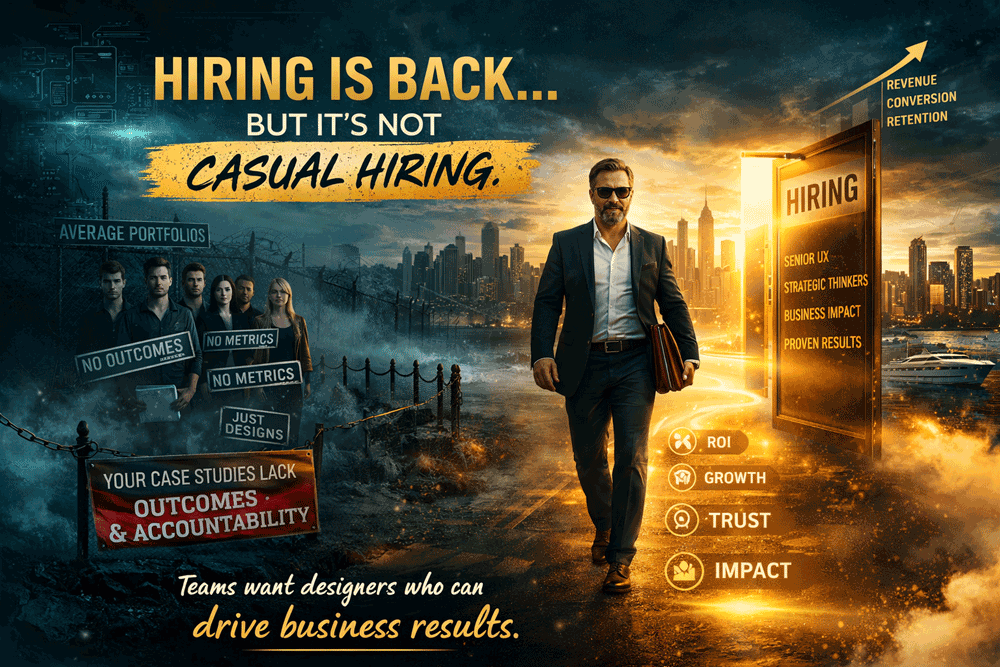

UX jobs are returning, but companies now demand executive-level designers who drive revenue and retention. If your portfolio only shows polished screens, you represent a risk. To land premium roles today, your case studies must demonstrate Trust Leadership (Ethics + Clarity) by showcasing measurable business outcomes and rigorous accountability.
Teams today need UX professionals who think like business partners, focusing on ROI and strategy rather than just visuals. Even after recent layoffs, demand for senior UX talent is stabilizing. A recent Figma survey reports that 82% of design leaders say their need for UX designers has increased or held steady, and 70% of hiring managers plan to recruit at least one UX professional this year.
But they are not hiring just any designer. They want an executive-grade UX partner who can protect the user while boosting business results.
I have spent over 25 years diagnosing complex friction points and building high-converting solutions for enterprise and SaaS clients. Look, the market has shifted. If you are searching for an “experienced ux no job offer” solution, here is the blunt truth: Your case studies lack outcomes and accountability. UI polish alone is no longer a differentiator. Nielsen Norman Group (NN/g) warns that top practitioners focus on “strategically solving problems to achieve business goals,” not just “making things pretty.”
Let’s break down how to stop sending junior signals and start projecting Trust Leadership to win your next premium UX job.
Why UX Trust Leadership Matters Now
When you sit across from a CEO or VP of Product, they are silently asking one question: “Can we trust you with our revenue?” If your case studies only show wireframes, sticky notes, or generic research, the answer is no. Companies want evidence of Trust Leadership, which combines two non-negotiable pillars:
- Ethics (Risk Mitigation): Do you actively avoid “dark patterns”? You must design for transparency and consent. Regulators like the US FTC and UK CMA are actively cracking down on hard-to-cancel subscriptions and buried fees. A senior UX architect argues against manipulative shortcuts, protecting the brand from legal fines and destroyed reputation.
- Clarity (Revenue Engine): Can you tie design choices to a clear why? How do your UX changes move the needle on revenue, retention, or support costs? You must use hard metrics (percentages, dollar figures) in your narrative.
Companies know that bad UX literally costs money. PwC found that 52% of consumers stop buying from a brand after a single bad experience. Conversely, Bain & Company showed that boosting customer retention by just 5% can lift profits by 25–95%.
Designing with ethics and clarity isn’t about being “nice”-it’s about safeguarding brand loyalty and driving profit.
Diagnosing the “No Offer” Trap: The Portfolio Audit
If you are an experienced designer getting auto-rejected, your portfolio is sending junior signals. A junior resume says, “I redesigned the dashboard to look more modern.” A senior resume says, “A confusing dashboard caused a 40% drop-off and 300 support tickets/month. I restructured the flow ethically, cutting tickets by 80% and saving ~$12K/month.”
Use this Senior-Signal Portfolio Scorecard to audit your current case studies. If you have too many “Junior Signals,” it is time to rewrite.
| Portfolio Element | The Junior Signal (Pixel Pusher) | The Senior Signal (Trust Leadership) |
| Defining the Problem | “Users found the app confusing.” (No data) | “A confusing onboarding flow caused a 30% drop in Day-1 retention, bleeding an estimated $50K/mo.” |
| Proposed Solution | “I created high-fidelity mockups and a UI kit.” | “I ran rigorous heuristic evaluations to isolate friction, reducing time-to-value by 2 minutes.” |
| The Outcome | “Users and stakeholders loved the new design.” | “Conversions increased by 14%, adding $1.2M to the annual pipeline.” |
| Accountability | “The dev team messed up the scope.” | “I led the trade-off analysis, documented constraints, and owned the metric improvements.” |
The Executive UX Case Study Framework
To prove your ROI, every portfolio project must read like a mini P&L (Profit & Loss) statement. Use this exact checklist to structure your case studies:
| Case Study Element | What You Must Include |
| 1. Business Problem | Quantified pain point (e.g., “$50K/mo lost to mobile cart abandonment” or “30% drop in free-trial activations”). |
| 2. User Friction | Specific user insight (e.g., “Heuristic analysis revealed users abandoned the form when confronted with hidden fees”). |
| 3. Ethical Choices | Design constraints or pushbacks (e.g., “Stakeholders wanted mandatory phone numbers; I argued an optional field with transparency improved trust”). |
| 4. Solution & Trade-offs | Clear architectural decisions (e.g., “Simplified the cognitive load and added transparency tooltips, phasing the rollout to meet deadlines”). |
| 5. Results & Metrics | Concrete outcomes (e.g., “Conversion lift of 14%, support tickets reduced by 20%, generating ~$200K in annual revenue”). |
Download UX Case Study Template PDF
Actionable Steps: Build Trust Leadership Skills Today
Transforming your portfolio requires practical skill-building. Here is how you apply this executive mindset immediately:
- Start with Business Value: Always open your case study with the revenue at risk or the user churn rate.
- Be Metric-Driven: Use before-and-after data. If you lack exact figures, use industry benchmarks or frame improvements as operational cost-savings (e.g., “reduced engineering rework by 15 hours/week”).
- Address Ethics Head-On: Explicitly mention an “ethical pivot.” (e.g., “I declined to implement the forced-continuity dark pattern because the compliance risk outweighed a short-term signup bump.”)
- Rewrite for Impact: * Before (Junior): “Created new UI for checkout.”
- After (Senior): “Identified a 22% drop-off at billing. By clarifying shipping costs and removing forced account creation, I increased successful checkouts by 14%, adding ~$75K in annual revenue.”
Download Heuristic Evaluation Guide
Mastering the Business of UX with UXGen Academy
You don’t have to navigate this market shift alone. Transforming from a visual designer into a strategic business partner requires new capabilities.
At UXGen Academy, our AI-Driven UX Mastery program is built specifically for experienced creatives ready to step into strategic, premium roles. Founded by myself, Mentor Manoj (25+ years in UX architecture, research, and hiring), this program skips the motivational fluff and focuses exclusively on career-ready skills.
How we enhance your enrollment in the premium job market:
- Advanced CRO Tactics: Learn to optimize conversion rates using hard data, not guesswork.
- Rigorous Heuristic Evaluations: Master the ability to audit enterprise platforms and isolate hidden revenue leaks.
- AI as a Strategic Lever: We teach you to use AI tools not just for speed, but to analyze massive user datasets to uncover friction points executives care about.
The curriculum is fully career-oriented. We use real case studies and your own portfolio as the lab. By the end of this live training, you won’t just know theory; you will be ready to lead boardroom discussions, proving how your UX decisions protect the user and grow the bottom line.
Conclusion & Next Steps
Hiring is not casual, and focusing on aesthetics alone will leave you behind. Top companies are aggressively seeking UX Trust Leaders who merge ethical design with absolute business clarity. Audit your work, rewrite your case studies to emphasize outcomes, and start thinking like an executive.
Ready to level up? Download our free Senior UX Case Study Workbook (PDF). It includes detailed templates, example narratives, and a checklist to inject Trust Leadership into your portfolio and watch your candidacy rise to the top.
Frequently Asked Questions
Q1: What is “Trust Leadership” in UX?
Trust Leadership combines ethical design (avoiding dark patterns) with business clarity (tying decisions to revenue and retention). It is the senior-level mindset of protecting customers’ interests as a direct path to sustainable, long-term business growth.
Q2: Why do senior UX roles require ethics and clarity?
At the senior level, you are entrusted with a company’s brand and revenue. Ethical decisions build user trust and prevent regulatory fines. Clarity (explaining the “why” in dollars or percentages) assures executives that your work aligns with business goals, mitigating their risk.
Q3: How can I demonstrate business impact if I don’t have exact revenue numbers?
Use proxy metrics. Did your design reduce customer support calls? Did it decrease the time it takes a user to complete a task? Did it reduce development rework? Frame these relative improvements as operational cost-savings and ROI drivers.
Q4: Why am I an experienced UX designer with no job offers?
If you have 5+ years of experience but no offers, your portfolio is likely sending junior signals. If your case studies focus heavily on wireframes, UI kits, and vague processes rather than measurable success and accountability, hiring managers will pass you over.
Q5: What does a “senior signal” look like in an interview?
A senior signal emphasizes constraints, trade-offs, and ROI. For example: “We had a tight budget and a 25% drop-off issue. I proposed a phased plan-Phase 1 fixed the immediate friction, boosting conversions by 12%, while Phase 2 addressed deeper UX debt.”
Q6: How does UXGen Academy help career switchers land premium UX jobs?
Led by Mentor Manoj, our AI-Driven UX Mastery curriculum teaches practical, enterprise-focused skills. We train you to conduct rigorous UX audits, perform CRO analyses, and craft case studies with clear business outcomes, transforming you into an executive-grade UX partner.

