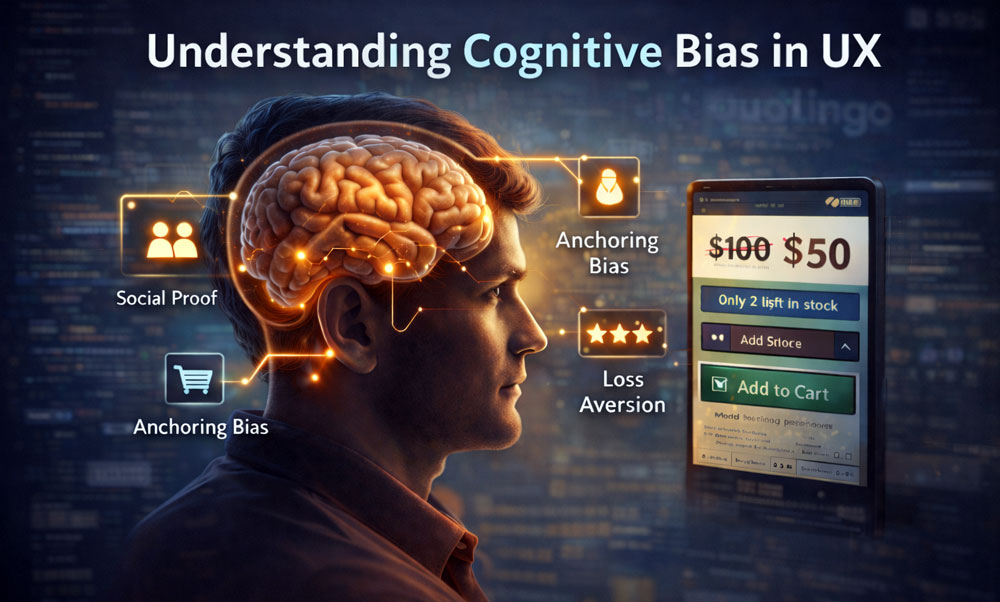
“We are predictably irrational. Our decisions are driven by deeply ingrained psychological biases, not just pure logic.” — Dan Ariely
- What is Cognitive Bias?
Cognitive Bias refers to the systematic errors in thinking that influence how humans make decisions and judgments. In the context of UX, it means users rarely evaluate interfaces, pricing, or products with perfect, calculating logic. Instead, they rely on subconscious mental shortcuts to decide where to click, what to buy, or whether to trust an app. Recognizing these biases allows you to design experiences that align with how the human brain actually works, rather than how we wish it worked.
- The Core Concept: Heuristics (Mental Shortcuts)
The human brain is bombarded with millions of data points every second. To avoid paralysis, the brain uses “heuristics”—mental shortcuts—to speed up decision-making. While these shortcuts save mental energy, they lead to predictable, irrational biases.
- If an item is marked down from $100 to $50, they perceive a massive bargain because of the initial number (Anchoring Bias).
- If they see thousands of five-star reviews, they trust the product without doing their own research (Social Proof).
- If they are afraid of losing progress or a digital asset they already possess, they will fight to keep it (Loss Aversion).
Good UX anticipates these psychological shortcuts to gently guide the user toward their goals.
- Key Takeaways for UX Designers
- Establish a Strong Anchor: The first piece of information a user sees sets the baseline for everything that follows. Place your most premium option first, or show the original price next to the discounted price to instantly establish high perceived value.
- Leverage Social Proof: People look to the behavior of others when they are unsure. Use testimonials, active user counts (“Join 10,000+ designers”), and reviews prominently near conversion points to reduce anxiety and build instant trust.
- Utilize the Decoy Effect: If users are experiencing decision paralysis between a cheap and an expensive option, introduce a third, slightly inferior option (the decoy) priced similarly to the expensive option. It makes the target option look like a no-brainer.
- Real-World Examples
- SaaS Pricing Tables (Anchoring & Decoy): Most software pricing pages highlight a “Pro” or “Most Popular” tier in the middle. By placing a highly expensive “Enterprise” tier right next to it, the “Pro” tier suddenly feels like a safe, logical bargain.
- Amazon’s “Only 2 left in stock” (Scarcity & Loss Aversion): E-commerce sites trigger the Fear of Missing Out (FOMO). Users speed up their checkout process because they are wired to avoid losing a rare opportunity.
- Duolingo Streaks (Endowment Effect & Loss Aversion): Duolingo users will log in daily—even when they are tired—just to avoid losing their hard-earned “streak.” They value what they’ve built and feel psychological pain at the thought of losing it.
- When Should You Beware of It?
While cognitive biases are powerful tools for improving conversion rates, there is a fine ethical line. You should intentionally beware of crossing into “Dark Patterns.” Never weaponize biases to deceive users. Do not use fake countdown timers (False Scarcity), trick users into adding hidden insurance to their carts (Sneak into Basket), or use confusing language to prevent them from canceling a subscription (Confirmshaming). Ethical UX uses biases to reduce decision fatigue and help users, not manipulate them into regret.
Summary for Designers
“Design for the human brain, flaws and all.” By understanding and ethically applying cognitive biases, you create persuasive, intuitive digital experiences that help users make confident decisions while seamlessly achieving your business goals.


