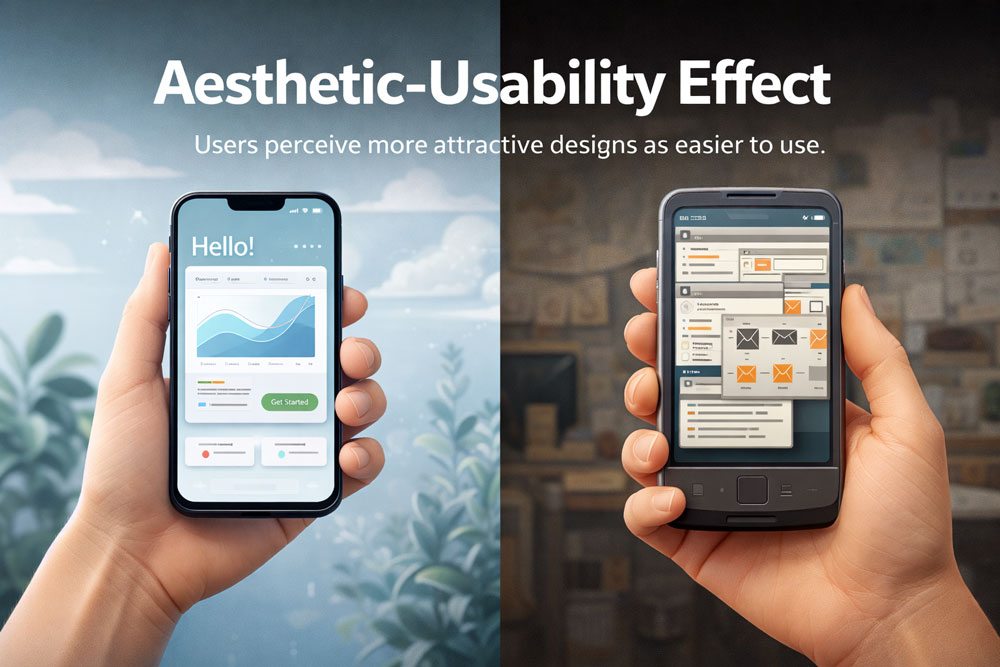
“Attractive things work better. When you wash and wax a car, it drives better, doesn’t it? Or at least it feels like it does.” – Donald Norman
- What is the Aesthetic-Usability Effect?
The Aesthetic-Usability Effect refers to the psychological phenomenon where users perceive more aesthetically pleasing designs as inherently easier to use than less aesthetically pleasing ones. In the context of UX, it means that an attractive interface can mask minor usability issues and foster a positive attitude. Recognizing this effect allows you to understand why users might forgive a beautiful app for a clunky feature, but quickly abandon an unappealing app for the exact same flaw. Beautiful design creates a positive emotional response that actively shapes a user’s perception of functionality.
- The Core Concept: Visual Forgiveness (The Halo Effect)
The human brain is naturally drawn to beauty, order, and symmetry. When a user encounters a visually appealing interface, it triggers an immediate positive emotional reaction. This positive feeling acts like a cognitive “halo,” extending to their judgment of the product’s actual functionality.
- If a product looks premium and well-crafted, users automatically assume it is functionally superior and highly reliable (The Halo Effect).
- If they encounter a minor friction point or bug, they are more likely to blame themselves or brush it off rather than blame the system (Visual Forgiveness).
- If an interface feels visually delightful, users are much more willing to invest the time and patience required to learn how it works.
Good UX leverages aesthetics not just to make things look “pretty,” but to build immediate trust, reduce perceived cognitive load, and increase user tolerance.
- Key Takeaways for UX Designers
- Invest in First Impressions: Users form their initial opinion of your product within milliseconds. High-quality typography, intentional whitespace, and harmonious color palettes immediately set a baseline of perceived competence and ease of use.
- Use Aesthetics to Build Trust: In sectors like SaaS, finance, or healthcare, a polished UI signals security and professionalism. A beautiful, well-aligned design reassures users that their tasks or data are being handled by a credible system.
- Don’t Use UI as a Crutch: While aesthetics can buy you patience, they cannot fix deeply broken user flows. Prioritize core usability first, and use visual design to enhance the experience, not to cover up fundamental architectural flaws.
- Real-World Examples
- The Apple Ecosystem (Visual Forgiveness): Apple devices and software are renowned for their minimalist, premium aesthetics. Even when Apple introduces a complex setting or a confusing new gesture, users are highly forgiving and willing to learn it because the overall visual experience is delightful.
- Modern FinTech vs. Legacy Banking Apps: Traditional banking apps often feature cluttered, outdated interfaces, leading to high user frustration. Modern FinTech apps (like Monzo or Robinhood) use sleek, modern UI, which makes users feel the app is faster, smarter, and easier to navigate, even if the core banking functions are identical.
- Dieter Rams’ Braun Products: Long before digital interfaces, Dieter Rams’ highly aesthetic and minimalist designs for Braun radios and calculators made complex electronics feel simple, approachable, and highly usable to the average consumer.
- When Should You Beware of It?
While the Aesthetic-Usability Effect is a powerful tool for improving user satisfaction, there is a dangerous trap: prioritizing form over function. You should intentionally beware of designing “Dribbble-friendly” interfaces that look stunning but fail in real-world scenarios. For example, using low-contrast light grey text might look elegant, but it destroys accessibility. Hiding essential navigation behind abstract icons might make a screen look clean, but it severely harms discoverability. Ethical UX ensures that aesthetic choices support and elevate usability, rather than sacrificing it for visual flair.
Summary for Designers
“Design for emotion, but test for functionality.” By understanding and applying the Aesthetic-Usability Effect, you can create visually striking digital experiences that build immediate trust, encourage user forgiveness, and spark delight-provided you ensure the underlying mechanics of your design are just as robust as its visual facade.


